Famous Painting Artists to Use for an Art Final
The Stories Behind the Final Works of 10 Famous Artists
Beautiful, tragic, or poignant, we accept a expect at the famous terminal works of ten artists
The final work of an creative person can be a startling window into their last moments. Beautiful, laced with sadness, or embracing death, we accept a look at the famous last works of ten renowned artists.
1. Georgia O'Keeffe — The Beyond (1972)

Georgia O'Keeffe (1887-1986) The Beyond, 1972, oil on canvas, 30 x xl in
Oft heralded as the "Female parent of American modernism", Georgia O'Keeffe is well known for her colorful oil paintings, depicting ultra-close-upwardly flowers, New York skyscrapers, and the barren landscapes of New Mexico. Towards the end of her life her eyesight deteriorated due to macular degeneration, leaving her with but peripheral vision. This was a devastating accident to the highly visual creative person, who was forced to finish oil painting in 1972, although she did go along painting with the assist of assistants thereafter. Notwithstanding, her concluding unassisted piece of work in oil, The Beyond (1972), is a towering work that looks death squarely in the confront. O'Keeffe seems to contemplate the magnitude of beingness and the impossible notion of what comes next.
2. Claude Monet — Les Grandes Décorations (1926)

Claude Monet (1840-1926), Lake of Water Lillies (Bassin aux nympheas), 1917-1920, 2 x 0.9m
Les Grandes Décorations (1920-26) are among Monet's most famous works — enormous curved murals that depict the famous h2o lilies that lined his beloved pond. Monet conceived of the idea when he was 70, and it took him x years to consummate the works. The artist painted Les Grandes Décorations when both his eyesight and health were failing. He had to build a new studio to accommodate the huge, 91 10 ii meter canvases, and in the process almost went blind from cataracts. As his eyesight declined, his works turned from brilliant, bright colors to blurred mixtures of browns and reds. Monet wrote messages to friends, describing how colors were getting irksome and indistinguishable — he even had to label tubes of paint. By the time the paintings were finally finished, Monet was on his deathbed. Generously, he donated the fruits of his last ten years to the French State, and the works were hung in 50'Orangerie Museum in Paris.
iii. Keith Haring — Unfinished Painting (1989)

Keith Haring (1958-1990), Unfinished Painting, 1989, Acrylic on canvas, 39 ten 39 in
Keith Haring skyrocketed onto the New York arts scene during the 1980s, and became well known for his distinctive visual language, which he used to explore social and political themes. The creative person and activist, who hung out with the likes of Andy Warhol, Madonna, and Jean-Michel Basquiat, began painting sublime and colorful works that confronted negative perceptions of homosexuality and AIDS. Unfinished Painting is a haunting final work, completed presently before Haring died from AIDS-related complications in 1990. The painting serves equally a touching statement near a life cut short at the tender age of 30-one, by an illness that the land was doing little to treat or forestall.
4. Jean-Michel Basquiat — Riding With Death (1988)

Jean-Michel Basquiat (1960-1988), Riding With Expiry, 1988, acrylic and crayon on canvas, 249 ten 289.5 cm
A gimmicky of Haring's, Basquiat was another electrical young voice in the 80s New York scene. Having started out every bit a graffiti creative person in the Lower E Side in the 1970s, past the 80s, Basquiat was exhibiting neo-expressionist paintings in galleries and museums internationally. Whether or not Riding With Death (1988) is in fact Basquiat's final painting is still a betoken of some debate. In whatever case, the work certainly has a distinctly morbid quality that evokes the sense of an catastrophe. Indeed, Basquiat painted it just months before his own decease from a heroin overdose in 1988. The skeleton has brown and black oil dripping from its rima oris, as if information technology has taken a bite out of the figure who rides him, and is standing to chew away. This could exist interpreted equally Basquiat reflecting the dangers his lifestyle was inflicting on him. The fine art critic Michael Dragovic suggests the piece of work represents a moment of clarity for Basquiat, noting, "The painting is deeply personal, and I believe it to exist a confession or realization of Basquiat'southward habits, because of its refined and calculated nature, and because his death followed and so apace after its completion."
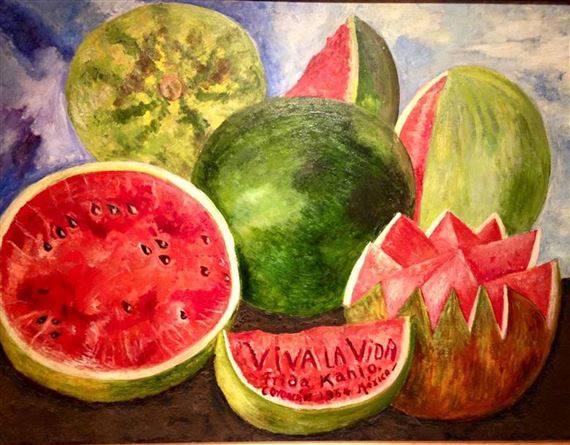
5. Frida Kahlo — Viva La Vida, Watermelons (1954)

Frida Kahlo (1907-1954), Viva La Vida, Watermelons, 1954, oil on maisonite, 59.5 x 50.8 cm
The beloved Mexican artist Frida Kahlo is well known for her magical realist self-portraits, and her brilliant and uncompromising depictions of female person experience. Viva La Vida (1954) is the artist's concluding work, completed just eight days before she died, aged 47 in 1954. The official cause of death was declared pulmonary embolism, but many believe her death to exist a suicide. Having spent months crippled after her leg was amputated at the knee, Kahlo was dealing with chronic pain, and had tried to take her life before. On the night she died, she gave her husband — the artist Diego Rivera — a wedding anniversary gift, over a month in accelerate. The painting is a even so life with watermelons, a fruit that in United mexican states is laden with cultural symbolism as a popular icon in the Dia de los Muertos — the festival of the Solar day of the Dead. Kahlo's inscription on the melons, viva la vida is a haunting phrase, meaning "long live life" in Castilian.
6. Diego Rivera — The Watermelons (1957)

Diego Rivera (1886-1957), The Watermelons, 1957, Oil on canvass
Kahlo's husband, Diego Rivera, was another prominent Mexican painter and cultural critic. His large frescoes helped found the Mexican Mural Movement, and his volatile relationship with Frida was the inspiration for many of her paintings. Some years her senior, Rivera died of natural causes at the age of 70, merely 3 years after his wife's untimely expiry. His last work was an oil on canvas painting, which, in a strange echo of his lover's called image, also depicts watermelons. The painting was supposedly produced afterwards Dolores Olmedo, 1 of his greatest supporters and patrons, commissioned him to paint information technology for her. Initially Rivera refused, proverb that he 'did not similar to paint watermelons'. Only when Olmedo threatened to commission another prominent creative person did the ever-proud Rivera agree. The Watermelons (1957) was the concluding painting he ever completed and signed.
7. Francis Bacon — Written report Of A Balderdash (1991)

Francis Bacon (1909-1992) Study Of A Bull, 1991, oil on canvas
The genre-defining figurative painter, Francis Bacon, died of a centre attack in 1992. It was a result of chronic asthma, which had plagued him all his life. Study of a Bull was completed just months earlier the artist died, but has never been seen publicly. Having spent the entirety of its beingness in a very individual London collection, the painting has never been exhibited, or even seen, save by a handful of people. In fact, information technology was only discovered some years after the artist's decease, when the fine art historian Martin Harrison was researching Bacon'southward work for the publication of the Francis Salary Catalogue Raisonné. Harrison suggests that Salary knew that he was shut to death when he was completing this striking work, and the painting represents the artist grappling with mortality. According to Harrison, "Bacon is ready to sign off … he was so ill… He knew exactly what he was doing here".
viii. Édouard Manet — A Bar At The Folies-Bergère (1882)

Édouard Manet (1832-1883) A Bar At The Folies-Bergère, 1882, Oil on sheet, 96 x 130 cm
The notorious French painter Édouard Manet was one of the kickoff 19th-century artists to paint mod life, becoming a central figure in the transition from Realism to Impressionism. His last painting is in fact one of his well-nigh famous and beloved, A Bar at the Folies-Bergère, which was completed in 1882, a year earlier he died after having his foot amputated due to gangrene. The painting shows Manet's commitment to realism, but has acquired much fence amid critics, due to its confusing use of perspective, equally the adult female's reflection in the mirror does not follow an verbal reality. It's slightly off tilt. Co-ordinate to Tate Mod, "In Manet's painting, a barmaid gazes out of frame, observed by a shadowy male person figure. The whole scene appears to be reflected in the mirror behind the bar, creating a circuitous web of viewpoints." The work originally belonged to Manet's neighbour, the composer Emmanuel Chabrier, who hung it over his piano.
nine. Marking Rothko — Untitled (1970)

Mark Rothko (1903-1970) Untitled, 1970, oil on sheet.
One of the masters of American Abstract Expressionism (although he declined this categorisation), Mark Rothko is known for his colorful and bold multiform paintings. In early on 1968, Rothko was diagnosed with a mild aortic aneurysm, merely ignored the doctor'southward orders and connected to drink and smoke heavily, avoid exercise, and maintain an unhealthy diet. According to his friend Dore Ashton, he became "highly nervous, sparse, restless". He began to plough his attention to smaller, less physically strenuous works, including acrylics on paper, and produced a number of decidedly gloomy works in darker, faded colors. Meanwhile, Rothko'southward marriage had become increasingly troubled, and he separated from his married woman Mell in 1969, before moving into his studio. On February 25, 1970, Rothko's assistant constitute the artist lying dead on the floor in front of the sink, covered in claret. He had cut an artery in his right arm with a razor blade. His last piece, mayhap prophetically, was bright red.
x. Henri Matisse — La Gerbe (1953)

Henri Matisse (1869-1954), La Gerbe, 1953, paper and gouache cut-out, 294 x 350 cm.
Henri Matisse was an enormously influential artist who helped define and shape the European visual civilization of the early 20th century. Best known as a painter, his expressive apply of color and brush strokes became indicative of the Fauvist style. Notwithstanding, in 1941, Matisse was diagnosed with abdominal cancer, and underwent surgery that left him unable to walk. Painting and sculpture became physically impossible, so he embraced a new type of medium — cut-outs. With the assist of his administration, he began creating cut newspaper collages, pre-painted with gouache and arranged to compose colorful and lively forms. His final work, Le Gerbe (1953), meaning The Sheaf, was a piece made from ceramic tile embedded in plaster, completed a yr before his death. Even in his final years, he continued to innovate, and redefine a movement.
For more on auctions, exhibitions, and electric current trends, visit our Manufactures Folio
0 Response to "Famous Painting Artists to Use for an Art Final"
Post a Comment